March 18, 2024
Kai Macann
The Gettier Problem
Can "know" something, if you believe for the wrong reason?
The Problem with Knowledge
Philosophers have long debated what it actually means to “know” something. For millennia, the standard definition of knowledge, largely attributed to Plato's dialogues, was a Justified True Belief. Under this framework, you possess genuine knowledge if, and only if, three distinct conditions are perfectly met:
- The proposition is, in objective reality, true.
- You believe the proposition.
- You have a rational justification for holding that belief.
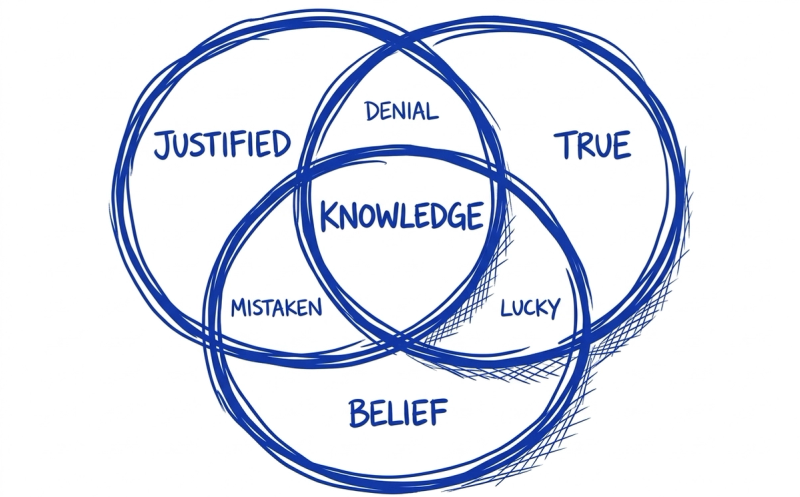
This tripartite theory of knowledge intuitively makes sense:
- You cannot 'know' something that is false
- You cannot 'know' something you do not even believe
- You cannot claim knowledge if you just made a lucky, unjustified guess.
Plato put it simply…
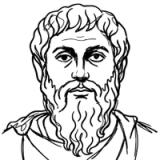 Plato:Knowledge is true belief accompanied by a rational account.
And this definition felt bulletproof, right up until 1963, when an American philosopher named Edmund Gettier dropped one of the shortest and most devastating papers in philosophical history, a three-page paper titled "Is Justified True Belief Knowledge?". He demonstrated that you can have a Justified True Belief that relies entirely on epistemic luck, fundamentally breaking the argument. One of the best ways to understand his argument is through a variation formalised later by Martin Cohen.
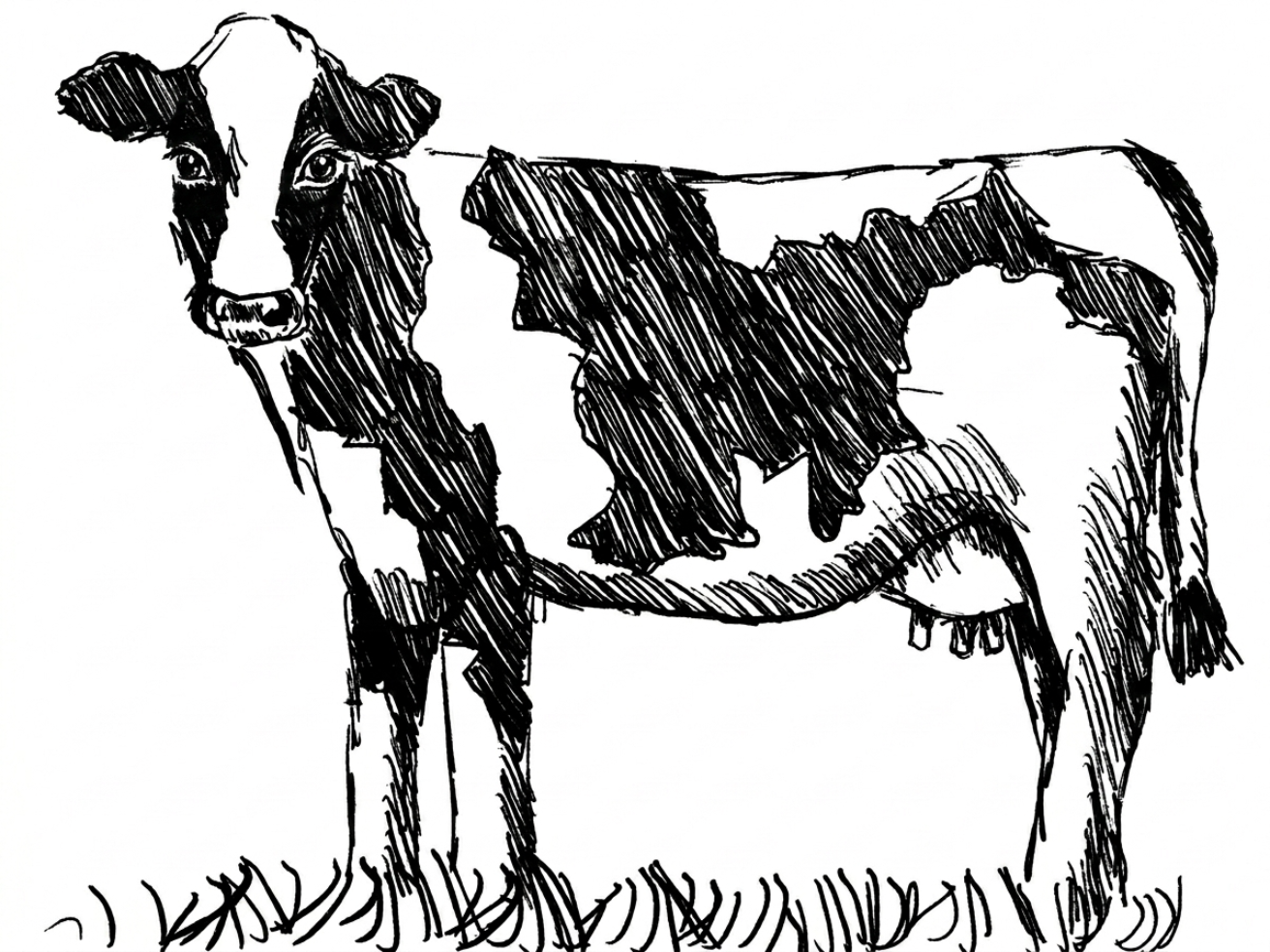
The farmer met all three criteria of Justified True Belief:
- He firmly believed Daisy was in the field.
- Daisy was, in objective reality, true to be in the field.
- He had a rational justification as he saw what he believed to be Daisy.
The cow in the field problem is one example of a “Gettier case“, a family of thought experiments tackling with epistemic luck. And this has repercussions outside of the dairy industry; in his original paper, Edmund Gettier outlined a slightly more complicated version.
Smith's deductive belief turned out to be entirely true and he was fully justified in believing it, however his justification was attached to the wrong man. He was right, but for the wrong reasons.
Can Smith legitimately claim he had knowledge about who would get the job?British philosopher Bertrand Russell touched on this problem decades earlier with another thought experiment.
Do you know the time, or did you just get lucky?And so, since 1963, Epistemologys have scrambled to "fix" the definition of knowledge by adding a fourth condition, attempting to turn the broken Justified True Belief model into JTB+X.
Fix 1: The 'No False Lemmas'
One of the earliest and most intuitive fixes was proposed by philosopher Michael Clark. He argued that the problem in Gettier cases is that the subject's final belief relies on an intermediary false assumption—a 'false lemma'. In the coin scenario, Smith's true belief rested on the false assumption that "Jones will get the job." In the farm scenario, the farmer's belief rested on the false assumption that "That black-and-white shape over there is Daisy."
Therefore, he suggested we amend the definition: Knowledge is a justified true belief that is not inferred from any false premises. This seems to solve Edmund Gettier's original cases perfectly. However, this defence was soon dismantled by a new wave of thought experiments where no logical inference or false premise occurs at all, but luck still plays a dominant role.
Does the 'No False Lemmas' condition seem like a sufficient fix?If you are in Fake Barn County, do you genuinely know you are looking at a real barn?Fix 2: The Causal Theory of Knowledge
Seeing the limitations of the 'No False Lemmas' approach, Alvin Goldman proposed a radically different fix: the Causal Theory. He argued that for a justified true belief to count as knowledge, there must be an unbroken chain of physical cause and effect between the actual truth of the proposition and the subject's belief in it.
This handles the Stopped Clock problem brilliantly. When you look at a working clock, the fact that it is 2:00pm physically caused the gears to move, which caused the hands to point to 2:00, which caused light to bounce off the dial into your retinas, causing your belief. But with the broken clock, the fact that it was 2:00pm in reality had no causal impact on the stuck hands. The causal chain was severed twelve hours ago, meaning your belief is not knowledge.
Yet, the Causal Theory struggles heavily with abstract truths. How do we have knowledge of mathematics or logic? The absolute fact that 2 + 2 = 4 doesn't exist as a physical object that can reflect light or 'cause' neurons to fire in our brains. If knowledge requires a physical causal chain, then we theoretically cannot 'know' anything about maths or ethics.
Do you think the Causal Theory successfully solves the problem?Fix 3: Process Reliabilism
Refining his own views, Alvin Goldman later pivoted towards Process Reliabilism. This theory discards the strict focus on individual justifications and instead looks at the cognitive mechanisms producing them. It states that a true belief is knowledge only if it is produced by a reliable cognitive process—one that yields a high ratio of true beliefs to false ones over time.
Under this lens, reading a broken clock is not a reliable method for determining the time, even if it happens to be right twice a day. Guessing the winner of a horse race based on a dream is not a reliable process. Using your unassisted eyesight in broad daylight, however, is generally reliable. But it runs into the 'Generality Problem': how specifically should we define the process? Is the process in Fake Barn County "using my vision" (highly reliable) or "using my vision to identify barns in a county filled with fake barns" (highly unreliable)? Establishing the exact boundaries of a process remains a contentious issue.
Does Process Reliabilism provide a robust definition of knowledge?Fix 4: Defeasibility Theory
Another prominent attempt to patch Justified True Belief is Defeasibility Theory. This approach argues that knowledge is a justified true belief for which there are no 'defeaters'. A defeater is an existing, objective truth that, had the subject known about it, would have completely destroyed their justification.
If you knew the clock was broken, you would not believe it was 2:00pm. The existence of the broken mechanism is a defeater. If you knew the locals were building papier-mâché structures, your justification for seeing a barn would vanish. However, this theory also encounters bizarre complications regarding 'misleading defeaters'—situations where a truth might unjustly destroy your perfectly valid reasoning. The search for a flawless definition continues.
Is Defeasibility Theory the best solution to the Gettier problem?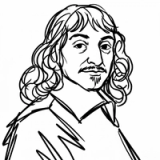 René Descartes:I doubt therefore I think, I think therefore I am.
Real-World Stakes
This isn't just an abstract puzzle for academics to argue about, distinguishing genuine knowledge from lucky guesswork has immense implications for how we function as a species.
- In the justice system, how do we decide whether to convict a suspect based on eyewitness accounts when the witness's visual justification could be totally coincidental?
- In scientific research, how can we know whether theories are absolute knowledge or marred by false positives?
- When we consume news, is it permissible to amplify posts that are true, but published by unverified sources or unreliable journalistic processes?
A completely flawless definition of knowledge might always elude absolute certainty. Perhaps what matters most is not achieving a perfect, untouchable state of knowing, but remaining continuously willing to maintain intellectual rigour, challenge our dogmatic beliefs, and rigorously audit the reasons we hold them.
Do you believe a completely flawless definition of knowledge can ever be found?